| Model & capacity | Fit & specifications | US offer |
|---|---|---|

Seagate IronWolfST4000VN008
|
4TB per bay. Check usable capacity after RAID and your NAS compatibility list. |
$225.00$56.25/TBView on Amazon ↗ — ST4000VN008, newChecked Sep 14, 2026 14:28 UTC |

Toshiba N300MN10ADA400ES
|
4TB per bay. Check usable capacity after RAID and your NAS compatibility list. |
$372.65$93.16/TBView on Amazon ↗ — MN10ADA400ES, newChecked Sep 14, 2026 14:27 UTC |

Western Digital WD Red PlusWD60EFPX
|
6TB per bay. Check usable capacity after RAID and your NAS compatibility list. |
$328.99$54.83/TBView on Amazon ↗ — WD60EFPX, newChecked Sep 14, 2026 14:25 UTC |

Seagate IronWolf ProST6000NE000
|
6TB per bay. Check usable capacity after RAID and your NAS compatibility list. |
$469.00$78.17/TBView on Amazon ↗ — ST6000NE000, newChecked Sep 14, 2026 14:25 UTC |

Toshiba N300MN10ADA800S
|
8TB per bay. Check usable capacity after RAID and your NAS compatibility list. |
$525.65$65.71/TBView on Amazon ↗ — MN10ADA800S, newChecked Sep 14, 2026 05:06 UTC |

Seagate IronWolfST10000VN0008
|
10TB per bay. Check usable capacity after RAID and your NAS compatibility list. |
$414.00$41.40/TBView on Amazon ↗ — ST10000VN0008, newChecked Sep 14, 2026 14:25 UTC |

Western Digital WD Red PlusWD101EFBX
|
10TB per bay. Check usable capacity after RAID and your NAS compatibility list. |
$520.49$52.05/TBView on Amazon ↗ — WD101EFBX, newChecked Sep 14, 2026 12:59 UTC |

Western Digital WD Red PlusWD120EFGX
|
12TB per bay. Check usable capacity after RAID and your NAS compatibility list. |
$459.99$38.33/TBView on Amazon ↗ — WD120EFGX, newChecked Sep 14, 2026 05:07 UTC |
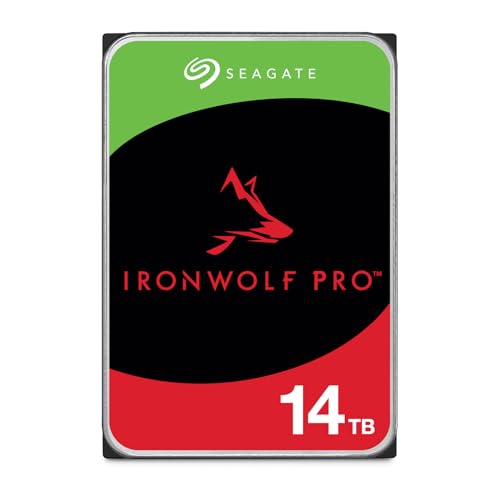
Seagate IronWolf ProST14000NT001
|
14TB per bay. Check usable capacity after RAID and your NAS compatibility list. |
$584.45$41.75/TBView on Amazon ↗ — ST14000NT001, newChecked Sep 14, 2026 14:25 UTC |

Western Digital WD Red ProWD161KFGX
|
16TB per bay. Check usable capacity after RAID and your NAS compatibility list. |
$704.99$44.06/TBView on Amazon ↗ — WD161KFGX, newChecked Sep 14, 2026 05:06 UTC |

Seagate IronWolfST18000VN000
|
18TB per bay. Check usable capacity after RAID and your NAS compatibility list. |
$844.45$46.91/TBView on Amazon ↗ — ST18000VN000, newChecked Sep 14, 2026 13:01 UTC |

Toshiba N300 ProHDWG82AXZSTB
|
20TB per bay. Check usable capacity after RAID and your NAS compatibility list. |
$912.35$45.62/TBView on Amazon ↗ — HDWG82AXZSTB, newChecked Sep 14, 2026 05:06 UTC |
Specifications: linked manufacturer model pages. Selection covers different capacities and families; it is not a reliability ranking. Prices are per listed drive; Amazon’s price and availability at purchase apply.
Build a shortlist your NAS supports
Use your enclosure manufacturer’s compatibility documentation for the exact model and software version. Check interface, capacity limits, sector format and any workload or bay guidance. CMR is a useful requirement for many NAS workloads, but it does not alone establish compatibility or future reliability. Keep a separate backup even when the NAS uses redundancy.
For a home NAS: Red Plus and IronWolf
The sourced Red Plus and IronWolf models in this catalog are SATA CMR drives. Their published limits include up to eight bays and 180 TB/year workloads. Exact variants differ: WD40EFPX and ST4000VN006 are 5,400 RPM models with 256MB cache, while the 8TB WD80EFPX and ST8000VN004 differ in spindle speed. Compare full model numbers rather than assuming every capacity in a family behaves the same.
Toshiba N300 is another model-level comparison
N300 is Toshiba’s NAS family. Its current EMEA product range includes separate retail and bulk part numbers and multiple capacities. Use the region-specific source to identify the hardware, then check local availability and warranty. A catalog entry can be useful even when we have no reviewed Amazon offer attached to it.
For larger capacity: enterprise SATA can be an option
Exos X18, Ultrastar HC550 and Toshiba MG07 include high-capacity enterprise options. Check the exact interface and suffix: SAS versions are not interchangeable with SATA drives. A renewed enterprise unit needs a separate assessment of seller, return window and warranty provider. An original manufacturer specification is not a guarantee about the condition or remaining life of that unit.
Compare the cost of the whole build
Calculate the number of drives required for your chosen layout and usable capacity. Compare like-for-like new or renewed offers and account for taxes, shipping, backup storage and power. Use price per TB as a starting point, then check compatibility and terms. This guide does not claim to rank failure rates or acoustics from hands-on testing; its recommendations are a specification-based shortlist.
Quick Decision Guide
| Need | Start comparing | Check before purchase |
|---|---|---|
| Home NAS | WD Red Plus / IronWolf | Exact model, bay support and capacity |
| Another NAS family | Toshiba N300 | Regional model code and warranty |
| Bulk storage / experienced buyer | Enterprise SATA models | SATA vs SAS and renewed condition |
Frequently Asked Questions
Are these recommendations based on Disk Scout benchmark testing?
Does a manufacturer warranty apply to a renewed offer?
Sources
Ready to find the best deal?
Compare Amazon US offers by capacity, condition and price per TB.
Related Guides
Compare HDD models for NAS
Filter the manufacturer catalog by intended use.
Red Plus vs IronWolf
Compare exact 4TB, 8TB and 12TB models.
Exos vs Ultrastar
Check enterprise model suffixes.
IronWolf vs IronWolf Pro
Compare the cost and operating limits of Pro.
WD Red Plus vs Red Pro
Choose by workload and eligible warranty.
NAS noise and power
Plan a NAS for the room where it will run.