What recent HDD failure data does—and does not—show
Backblaze’s Q1 2026 report, published July 9, analyzed 341,263 qualifying data drives and reported a 1.24% annualized failure rate for that quarter. AFR is failures normalized by time in service. It is not a median lifespan, nor a forecast that a particular home drive has a 1.24% chance of failing next year. The report describes a managed data-center fleet, with inclusion rules and limitations in capturing day-one failures. Use the model, age, drive-days and observation period together.
Source: Backblaze Q1 2026 Drive Stats: cohort, AFR and collection limits
Can a hard drive last five or ten years?
Yes, some do, but surviving examples do not establish the survival rate of all purchased drives. Backblaze’s December 2021 analysis reported about 90% survival at four years and 65% beyond six years in its then-observed fleet. Those dated cohort results should not be presented as a universal six-year lifespan or a replacement deadline for today’s models. Its observed failure curve also differed from the classic bathtub illustration. An age-only rule misses both early faults and long-lived units.
SMART can warn you, but it cannot predict every failure
The Google fleet study presented at FAST 2007 found correlations between some SMART indicators and failures, while concluding that SMART alone was insufficient for predicting individual drive failure. Treat recurring uncorrectable errors, increasing suspect-sector counts, failed self-tests or repeated disconnects as reasons to investigate promptly. Follow the manufacturer or NAS interpretation of the exact attributes: raw SMART counters are not interchangeable between every model. A clean status does not make the only copy of a file safe.
Source: Google researchers, FAST 2007: Failure Trends in a Large Disk Drive Population
When should you replace a drive?
If a drive is reporting errors, first protect any still-readable important data using an appropriate backup or recovery path. Avoid unnecessary stress tests on a suspected failing unit that holds the only copy. If the data is irreplaceable or the drive makes unusual mechanical noises, stop and consider professional recovery. For a healthy drive, weigh growing capacity needs, warranty eligibility, compatibility and the cost of an unplanned outage. Schedule replacement while the system is working instead of treating a birthday as proof of failure.
Does running 24/7 make an HDD wear out faster?
Power-on hours are one part of the operating history. Follow the exact model’s temperature, vibration and workload limits and the enclosure’s cooling requirements. A NAS label does not mean every capacity includes the same sensors or operating ratings. Do not assume daily shutdowns are always better or always worse, or that a workload written for one model applies to another. Record the conditions and health history alongside the serial number.
How long will an unplugged backup drive keep data?
An unplugged drive has no universal guaranteed retention period. Store it within the manufacturer’s conditions, keep another independent copy, and periodically verify that files can be read and restored. Make that verification frequency part of the backup plan, based on the value of the data and the difficulty of replacing it. A second drive sitting beside the first does not protect against a shared fire or theft. Plan a copy in a separate location.
Do SSDs last longer than HDDs?
SSDs have no moving heads or platters, but they have write-endurance ratings and can fail for other reasons. That does not establish a universal lifespan winner. Compare capacity-specific endurance for heavy writes, physical handling for portable use, and independent backups for either technology. When upgrading, budget for the replacement and a verified migration rather than spending everything on the new drive.
Replacement decisions by evidence
| What you observe | What it tells you | Next step |
|---|---|---|
| Healthy drive, enough capacity | No known fault; not proof against future failure | Maintain backups and alerts; plan for downtime |
| Growing errors or a failed diagnostic | A fault needs investigation | Protect readable data and plan replacement |
| Clicks, damage or inaccessible unique data | Repeated operation may worsen recovery prospects | Stop unnecessary use and assess recovery |
| Older drive with clean SMART | Age and SMART do not predict an expiry date | Weigh outage cost, support and capacity needs |
| Offline backup not checked recently | Stored files have not been verified | Test reading/restoring; retain another independent copy |
| Model & capacity | Fit & specifications | US offer |
|---|---|---|
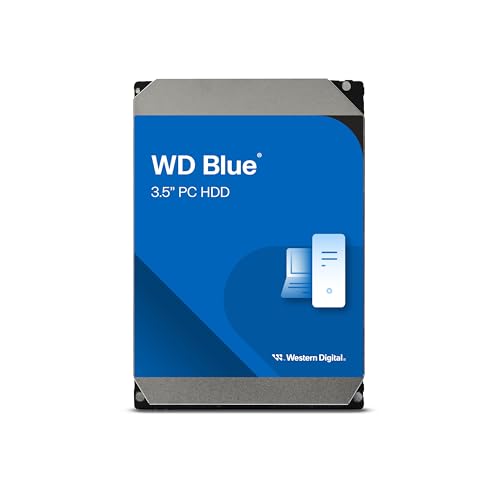
Western Digital WD BlueWD40EZZX
|
Bulk files or game archives. Check the game’s SSD requirements for active installations. |
$179.99$45.00/TBView on Amazon ↗ — WD40EZZX, newChecked Oct 27, 2026 12:21 UTC |

Seagate IronWolfST6000VN001
|
6TB per bay. Check usable capacity after RAID and your NAS compatibility list. |
$319.00$53.17/TBView on Amazon ↗ — ST6000VN001, newChecked Oct 27, 2026 13:33 UTC |

Toshiba N300MN10ADA800S
|
8TB per bay. Check usable capacity after RAID and your NAS compatibility list. |
$492.82$61.60/TBView on Amazon ↗ — MN10ADA800S, newChecked Oct 27, 2026 13:34 UTC |

Western Digital WD_BLACKWD102FZBX
|
Bulk files or game archives. Check the game’s SSD requirements for active installations. |
$469.99$47.00/TBView on Amazon ↗ — WD102FZBX, newChecked Oct 27, 2026 05:16 UTC |

Seagate IronWolfST12000VN0008
|
12TB per bay. Check usable capacity after RAID and your NAS compatibility list. |
$529.94$44.16/TBView on Amazon ↗ — ST12000VN0008, newChecked Oct 27, 2026 12:24 UTC |

Seagate BarraCudaST24000DM001
|
Bulk files or game archives. Check the game’s SSD requirements for active installations. |
$1,099.95$45.83/TBView on Amazon ↗ — ST24000DM001, newChecked Oct 27, 2026 13:32 UTC |
Specifications: linked manufacturer model pages. Selection covers different capacities and families; it is not a reliability ranking. Prices are per listed drive; Amazon’s price and availability at purchase apply.
Frequently Asked Questions
Should I replace every hard drive after five years?
Is 30,000 power-on hours a lot for a hard drive?
Can an HDD fail without a SMART warning?
Does a low annualized failure rate mean a long lifespan?
Ready to find the best deal?
Compare Amazon US offers by capacity, condition and price per TB.